Sermo / Trust & acquisition
When Real Physicians Became the Most Persuasive Messengers
An unscripted member-story experiment that materially improved acquisition efficiency and created reusable assets across the member journey.
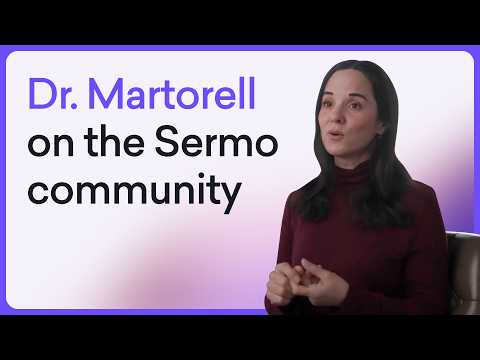 Dr. Claudia Martorell · Watch video
A credibility need, not just a creative problem
Physicians are a demanding audience to reach. They are time-constrained, highly trained, and accustomed to weighing evidence. Sermo could explain the benefits of joining its professional community, but a company could not fully convey what membership felt like from a physician’s perspective. Physicians also had good reason to place particular trust in their peers: fellow doctors had been through comparable education, training, and clinical decision-making, and understood the realities of their work.
Trust was central to the decision. We wanted prospective members to hear from doctors who had already chosen to participate, while also giving newly registered members a welcome that felt more personal than a standard brand message.
Why we left the script behind
The opportunity came when three physicians on Sermo’s Medical Advisory Board were attending an event where we could film them together. We planned nine distinct stories for different moments in the member experience, from acquisition ads to welcome communications.
We debated whether to script the answers. A script would ensure consistency with our messaging and potentially make production easier. But it could also strip away the most important thing the physicians offered: the credibility of speaking in their own words.
We chose guided, unscripted interviews. Questions explored why physicians joined Sermo, what they used it for, what they valued about the community, and what they would tell a new member. That approach introduced some production uncertainty, but it aligned directly with the objective of building trust.
Designing an experiment around outcomes
Working with creative, community, and production partners, we prepared multiple edits and formats, including short-form social ads, subtitled versions, and content for digital onboarding. A single shoot could serve several parts of the member lifecycle.
We tested physician testimonial videos against static creative on Facebook and Instagram, tracking acquisition volume and cost per acquisition. Existing members were excluded from the acquisition audiences. Campaign tagging helped distinguish creative and placement results.
The results strongly favored video: physician testimonials generated more than 60% of conversions, and in the documented comparison their cost per acquisition was 78% lower than that of static creative.
The video assets also remained effective longer before creative fatigue appeared: roughly six to eight weeks, versus two to four weeks for the static advertisements.
The wider impact
The test helped establish paid social as a viable acquisition channel at Sermo. It later became one of the company’s largest sources of new members.
We also extended the content beyond advertising. Member stories were placed within relevant Physician Resource Guides, in welcome emails, and in community posts. Existing members could help prospective members make a decision and help newcomers understand how to begin participating.
An authentic customer story is more than a conversion asset. Properly developed, it can be part of a broader system for building trust through acquisition, onboarding, and engagement.
Principles in Practice
- When trust is the objective, authenticity can matter more than message control.
- Validate creative performance against conversion economics, not just platform delivery.
- Develop customer stories as reusable relationship assets, not disposable campaigns.